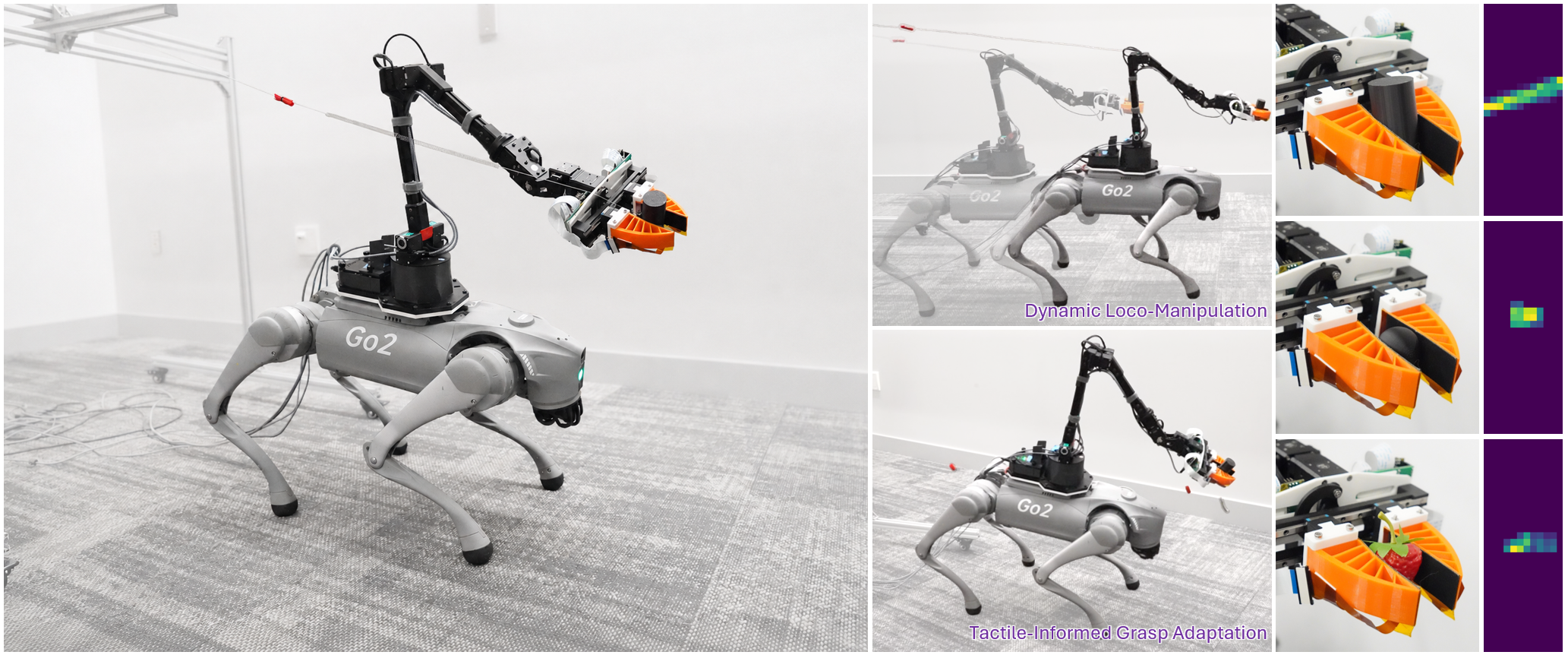
Dynamic loco-manipulation requires legged robots to coordinate whole-body motion while maintaining stable physical interaction with grasped objects under uncertain external forces. While tactile sensing has been widely studied for robotic manipulation, its role in dynamic whole-body control remains largely unexplored. Existing works without tactile feedback commonly grasp firmly rather than regulate the grasp according to the interaction. We propose TAC-LOCO, a tactile-augmented unified reinforcement learning framework that encodes tactile array observations from compliant grippers into a compact latent representation and joins it with proprioception for unified control of the legs, arm, and gripper. With effective grasp stability reward design, the policy learns to simultaneously track body velocity and end-effector trajectories, moderate grasp force, and prevent object slip under both gradual load changes and sudden release events. We deploy the policy zero-shot on a Unitree Go2 with an Interbotix WidowX 250 arm and tactile gripper, demonstrating dynamic tactile-informed loco-manipulation under varying external interactions, achieving a 47% reduction in grasping force and an object drop rate of less than 1%.
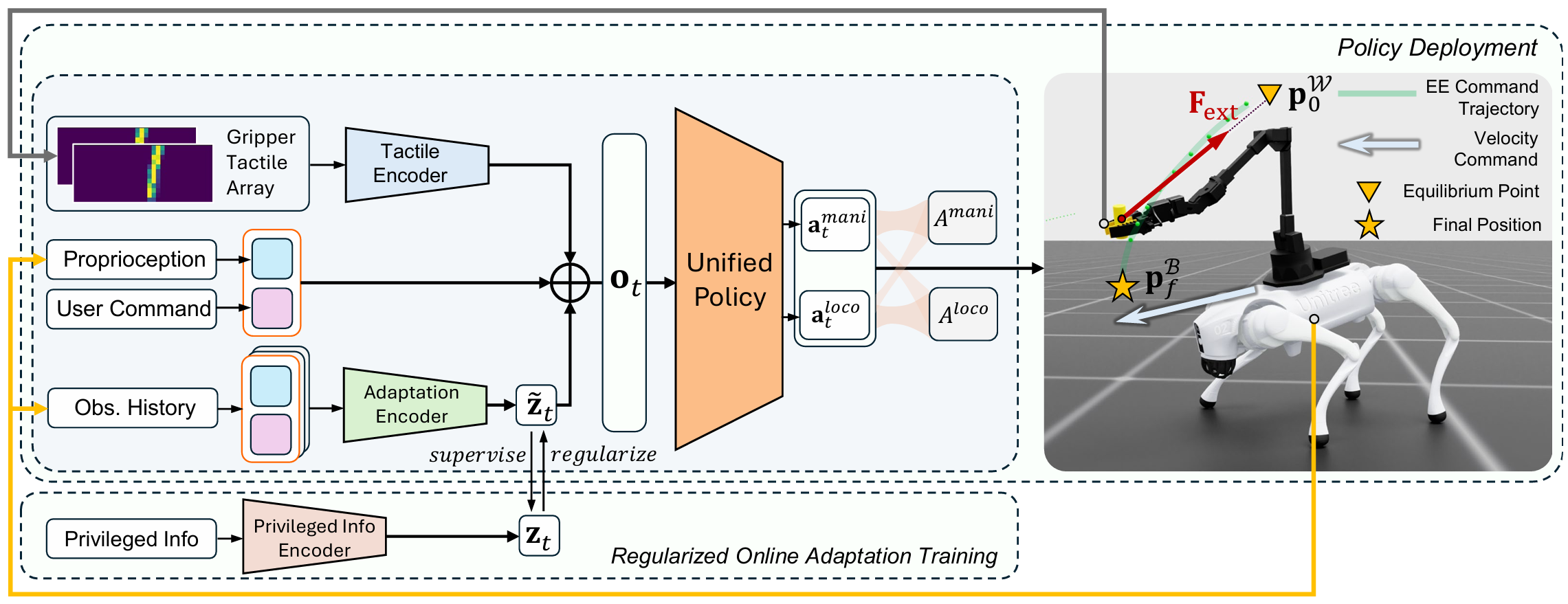
TAC-LOCO encodes high-dimensional tactile-array readings from the gripper into a compact latent representation and concatenates it with proprioception, user commands, and encoded observation history. A shared unified policy then branches into locomotion and manipulation action heads, jointly controlling leg joints, arm joints, and gripper width for grasp-aware whole-body control.
Two tactile arrays on the gripper fingers are normalized and encoded into a compact tactile latent. This gives the deployable actor direct information about contact area, contact distribution, and potential slip while avoiding direct concatenation of high-dimensional tactile maps.
The grasp stability reward combines force moderation, slip suppression, and object retention. Together, these terms encourage the policy to maintain secure contact under time-varying external forces without relying on unnecessarily tight, force-intensive grasps.
The policy transfers zero-shot to a Unitree Go2 with a back-mounted Interbotix WidowX 250 arm and tactile gripper. The robot maintains object contact during large whole-body motions and during walking loco-manipulation, including sudden force-release events caused by magnet detachment.
Without any fine-tuning, the policy successfully completes the task while grasping a sphere and an artificial strawberry, demonstrating that it does not rely on a fixed object shape or contact pattern.
During loco-manipulation, randomized perturbation forces up to 5.6 N are manually applied to the grasped artificial strawberry in directions independent of the nominal spring-damper force. The robot maintains stable locomotion and object retention while completing the task.
TAC-LOCO tracks long end-effector trajectories over a large workspace, while maintaining object retention under gradual force increase and sudden release events.
@misc{hu2026taclocounifiedwholebodycontrol,
      title={TAC-LOCO: Unified Whole-Body Control for Quadrupedal TACtile-Informed LOCO-Manipulation},
      author={Muqun Hu and Yuhao Zhou and Kabir Ray Malik and Chi Lin and Won Suk Lee and Yu She and Yan Gu},
      year={2026},
      eprint={2607.10132},
      archivePrefix={arXiv},
      primaryClass={cs.RO},
      url={https://arxiv.org/abs/2607.10132},
}